Showing posts with label technology. Show all posts

Wednesday, February 17, 2010

SEO friendly content management system

Content Management System (CMS):

Content Management System permits web site administrators to update, add or to delete the content, documents and photos to their web sites in “real time”. Content Management Systems generate an active web site milieu, where the entire content is stocked up in a database or in a XML file. In the era of high paced world of web, a high-quality CMS is vital to the proficient operations of a web site and Netzwerkinstallationen. CMS (Content Management System) permits the web site owner to outsource their content development tenuously to contract copywriters and further agreeable contributors.

CMS in SEO souk:

One of the chief and significant things that people should consider while looking for content management systems (CMS) is their practicality in the SEO souk. People at the time are really very confused about picking up a CMS that is absolutely compatible to their needs. To eradicate such confusion out of the minds, here are some of the SEO friendly content management systems:

Typo3:

Typo3 is very friendly to search engines and comes with lots of alternative for metadata and also for urls that are counted as search engine friendly.

Elxis:

Elxis is amazingly search engine friendly and deserves a good place in the list of systems. It is built up with SEO Pro capabilities. Even Mambo and Joomla are not capable of surpassing this.

What is SEO Pro..?

Elxis CMS produces search-engine as well as human friendly URLs with its powerful mechanism of working. SEO PRO is an essential part of the Elxis core; it is not a constituent or some class of additional software. Moreover, SEO Pro not demands any kind of supplementary settings other than its commencement.

The URLs are robotically produced from Elxis and are entirely based on SEO titles. This also increases the validation of SEO friendly titles.

Drupal:

Enable the sparkling urls and with a choice of SEO friendly plugins, Drupal is a well- known and a trouble-free content management system which is absolutely search engine friendly. Drupal works with an amazing module known as SEO Checklist.

MODx:

MODx is the most preferred choice and comes with capability of adjusting the meta- content for your website. Meta-content adjustment is done on the basis of per-page. Urls are completely SEO friendly.

Content Management System (CMS) Made Simple:

If you really want to amend .htaccess files, this unique and adjustable system can generate great quality of SEO friendly URLs. Also, it can build up variety of Page titles and Meta tags in an automatic manner and that can also be updated manually for individual pages later.

Overview:

It is sure that SEO friendly content management systems definitely work for you. The most important key is to search out for a CMS that will perfectly suit to fulfill your core needs and can conclude about the beneficial add-ons as well. Hence, you will get the ultimate results for your websites.


Source: freehelpsoft.com


SEO friendly content management system Re-Posted By Software Solution Services

Sponsored By: Software Development Company | TYPO3 Developer
Read More

Tuesday, February 2, 2010

Google Chrome Steals Users from Firefox, IE

Google's Chrome gained browser market share in January at the expense of both Microsoft's Internet Explorer and IE's biggest rival, Mozilla's Firefox, according to data published today.

Chrome, which only recently grabbed the No. 3 spot from Apple's Safari, ended January with a share of 5.2%, up 0.6 of a percentage point, said Web metrics company NetApplications.com. The increase, although slightly less than Chrome's jump during December, was the browser's second-largest since Google debuted the program in September 2008. Chrome has doubled its share since July 2009.

IE, meanwhile, lost half a percentage point to end January with a share of 62.2%, another record low in a long decline that cost Microsoft 's browser 10% of its share in the past year alone. If IE maintains the pace of the last three months, the browser will slip below the 50% mark in April 2011.

Firefox's share also dropped in January, the second monthly decline in a row. This was only the second time in more than two years that Firefox had lost ground in two consecutive months. Firefox ended January down 0.2 of a percentage point, to 24.4%. According to NetApplications, Firefox has yet to hit the magic 25% mark, having come closest in November 2009 before growth stalled.

Although Firefox 3.6 , which Mozilla released Jan. 21, grew by 0.7 of a percentage point and ended the month with a 1.1% share, the new version's launch couldn't stem the losses for the open-source browser overall.

Safari's share was up slightly, to 4.5%, while Opera Software's desktop browser was down slightly to 2.4%.

Microsoft's IE6 -- which Google recently announced it would stop supporting in some of its services -- again lost share last month, dropping 0.9 of a point to 20.1%. The newer IE7 also again fell, losing 1 percentage point and finishing January with a 14.6% share. Both declines were somewhat under the torrid pace of the last three months, when each edition lost more than a point per month.

IE8, the browser Microsoft issued in March 2009, captured some but not all of its siblings' losses: IE8 ended January with a share of 22.3%, up 1.5 points.

When NetApplications accounted for IE8's "compatibility view" -- a feature that lets users display sites as rendered by the older, and often Web standard-incompatible IE6 and IE7 -- Microsoft's newest browser owned a 25.1% share, making it the most popular single edition of any browser by a five-point margin.

The persistent decline of IE has long been a bane to Microsoft and a boon to rivals. But in the last two months, Firefox -- normally the browser to reap the most from IE's fall -- has been shoved aside by the newcomer Chrome. Over the last three months, Chrome has outgained Firefox by 5:1, posting an increase of 1.62 points to Firefox's 0.32 point. Even over a longer run, Chrome has boosted its share more than Mozilla's: Over the last 12 months, Chrome has gained 3.68 points, Firefox 2.3 points.

Chrome has already met the first goal that Google set last year when the browser's engineering director said Chrome would own 5% of the market by September 2010, and 10% by September 2011. If Chrome can keep up the pace it's made during the last three months, it will break the 10% mark in November, 10 months ahead of schedule.

NetApplications.com measures browser usage share by collecting systems data from the computers that visit the 40,000 sites it monitors for clients.

January's browser data is available on NetApplications' site.

Gregg Keizer covers Microsoft, security issues, Apple, Web browsers and general technology breaking news for Computerworld . Follow Gregg on Twitter at @gkeizer , send e-mail to gkeizer@ix.netcom.com or subscribe to Gregg's RSS feed.

Source: pcworld.com
Read More

Thursday, January 7, 2010

Software Development | .NET Software Development & Programming Services

.NET software development / programming / coding India

Microsoft .NET is a technology that connects information, people, systems and devices. .NET connects a broad range of personal and business technologies, enabling the access and use of important information, whenever and wherever it is needed. Built on XML Web service standards, .NET enables both new and existing applications to connect with software and web application to the services across platforms, applications and programming languages.

.NET Development India helps our clients' to design, develop and integrate business solutions based on the .NET platform. .NET Development India’s Microsoft .NET team develops and delivers comprehensive solutions utilizing the full capability of .NET functionality. Our experienced Microsoft certified software architects develop and consult work with you to understand your requirements and demonstrate the capabilities of .NET framework and develop the system to the requirements.

Microsoft .NET was built for integration through XML Web services using protocols and file formats such as SOAP (Simple Object Access Protocol), WSDL (Web Services Description Language), and UDDI (Universal Description, Discovery, and Integration). Our developers have done extensive work in ASP.NET, VB.NET, and C # by creating truly entire application integrating with in-depth implementation of MVC (Model View Controller).
Source: software-webdevelopment-dotnet.blogspot.com
Read More

Thursday, December 31, 2009

Flickr co-founder Presses Beta Button

Once you're lucky, twice you're good? So went the title of a recent book about Web 2.0 entrepreneurs. Pretty soon, we may have an idea whether it applies to Caterina Fake.

Fake, the co-founder of Flickr, announced on her blog Friday afternoon that her new start-up, Hunch, is sending out invitations to try the service, now in beta test.

What is it? I'll hand the reins over to Fake and let her explain:

Look. Decision-making is difficult, and decisions have to be made constantly. What should I be for Halloween? Do I need a Porsche? Does my hipster facial hair make me look stupid? Is Phoenix a good place to retire? Whom should I vote for? What toe ring should I buy?

It's dark and lonely work. Coin-flipping, I Ching consultation, closing your eyes and jumping, postponing the inevitable, Rock-Paper-Scissors, and asking your sister are all time-honored means of coming to a decision--and yet we think there's room for one more: Hunch.

Hunch is a decision-making site, customized for you. Which means Hunch gets to know you, then asks you 10 questions about a topic (usually fewer!), and provides a result--a hunch, if you will. It gives you results it wouldn't give other people.

Will it fly? Who knows, but in the midst of this miserable economic depression, there probably are lots of people out there who feel as if they don't have a clue anymore.

Source: http://news.cnet.com/8301-17939_109-10206217-2.html
Read More

Tuesday, December 29, 2009

Social Media Marketing With Twitter – An Introduction

As a business owner, you have likely heard of social media marketing. You may even have been curious enough to investigate it. And you may have been overwhelmed by the many options available to you. Between Digg, Delicious, Facebook, LinkedIn, Twitter and all of the many others, it is difficult to know where to start.

Twitter is one of the newer entries in the social media marketing field. Launched in 2006, it has become an enormously popular way for people to connect and keep in touch. Like any form of social media, it has also attracted businesses keen to get on the bandwagon of social media marketing.

Using Twitter as a Marketing

Twitter is often referred to as a micro-blog. Instead of posts, you write “tweets” of 140 characters or less. You can follow other users with similar interests, and they can follow you. Each time you add an update, all of your followers receive a message. They can choose to respond or not.

As with any social media marketing site, using Twitter requires you to be involved. You need to follow and be followed. You also need to provide information of value to the people who follow you. One example is links to your blog or other relevant information on your site.

Using Twitter for marketing does take time (as does any attempt at social media marketing). You need to build a community of followers and engage with other users to create credibility. To make links, you have to have something interesting to share with people, which means you need to spend time creating enough current, relevant, interesting and (occasionally) thought-provoking content for your followers to read.

Tips for Using Twitter as Part of Your Online Marketing

There are some basic rules to follow when using Twitter for marketing. In fact, many of these rules apply to other social media sites too, like Facebook.

Do not spam or engage in hard selling. Remember to be sociable and offer information of value. Blog posts on the benefits of your product or services, interesting conferences or professional development opportunities that are coming up – these are good examples.

  • Always link back to your site or blog. That is why you are doing this in the first place.
  • To get followers, put a link on your site or blog inviting people to follow you on Twitter. Twitter provides the code for a “badge” that you can drop into your Website or blog.
  • Search Twitter for likeminded users/businesses and see who they are following. You may be interested in following the same users.
  • Follow the lead of those who came before you. There are users with hundreds of followers. Check out what they are tweeting about so you can get ideas.

Use Twitter as Part of a Detailed Social Media Marketing Strategy

Of course, if you are using social media for marketing, you need to have a comprehensive plan. To create a plan like that, you may need help from a search engine marketing consultant. In addition to tweeting on Twitter (which can eat up a lot of your time) you need to have a schedule for blogging and writing articles to link to.

As part of this strategy, develop a plan for your content. Don’t throw any old thing up there just to have something to link to. A consultant can show you how to create compelling copy that makes your blog, articles and Website work with your social media marketing, so that you are drawing traffic through as many channels as possible.

Source From: homebasedblogging.com
Read More

Monday, December 28, 2009

Open Source CMS market share report 2009

The 2009 Open Source CMS market share report was released a couple of weeks ago. The report concludes that WordPress, Joomla! and Drupal maintain a large lead on the rest of the pack, and that they are the dominant players in the market.

Despite the rather lengthy nature of the survey, more than 600 persons completed the question set. The demographic data gathered shows the survey group to be primarily composed of senior IT professionals working in smaller organizations of 1 to 5 people. More than 80% of the participants had heard about Joomla!, Wordpress and Drupal, though most of them were more familiar with Wordpress and Joomla!. Continue Reading
Read More

Friday, December 25, 2009

7 Creative and Interesting Infographics about Twitter

By Xavier Lur

With over 54 million users worldwide and close to 7 billion tweets being posted, Twitter is the world’s most popular micro-blogging platform, fueled by smartphones and online bursts of 140 characters. 2009 is the year of Twitter. It soared to lofty heights over the past year, all thanks to the active presence of celebrities such as Ashton Kutcher and Oprah Winfrey. The San Francisco-based Internet company isn’t a social networking website like Facebook or MySpace. Instead, the main focus of Twitter is about real-time information of the things you care about Ć¢€” work, industry, company, news.

2010 will be the revenue year of Twitter. The micro-blogging juggernaut will focus on generating revenue in the year ahead, and may explore options including an initial public offering. “2010 is really going to be the revenue year. I don’t know if we’re going to be profitable, but we have plenty of time,” said co-founder and creative director Biz Stone during an Oxford University event in November.

Today, I’d like to share with you guys ‘7 Creative and Interesting Infographics about Twitter‘. Enjoy and don’t forget to tweet about this post! :D

1. The Journey of a Tweet

Timon Singh from NGONews has created an infographic which shows the journey of a Tweet and how it evolves from a simple 140-character long message to a Google news story.

journey


2. The Many Users of Twitter

Ordinary people use Twitter to share with their friends and co-workers what they are doing; bloggers, Internet marketers, and businesses use Twitter to promote their articles/products; politicians use Twitter to garner support; celebrities use Twitter to stay in touch with their beloved fans, and spammers use Twitter to send unsolicited messages.

Inspired by Guy Kawasaki, “The Many Users of Twitter” is an infographic designed by the folks at NGONews. According to Guy Kawasaki, there are six types of Twitter users – Newbie, Brand, Smore, Bitch, Maven, and Mensch. So which one are you?

profiles


3. Information creation and circulation before and after Twitter

Designed by Burson Marsteller, the “before Twitter” infographic shows that time is necessary for the information to spread before its arrival on Twitter. On the other hand, the “after Twitter” infographic reveals the changes of the information circulation with the development of the use of Twitter.

Before Twitter

beforetwitter

After Twitter

aftertwitter


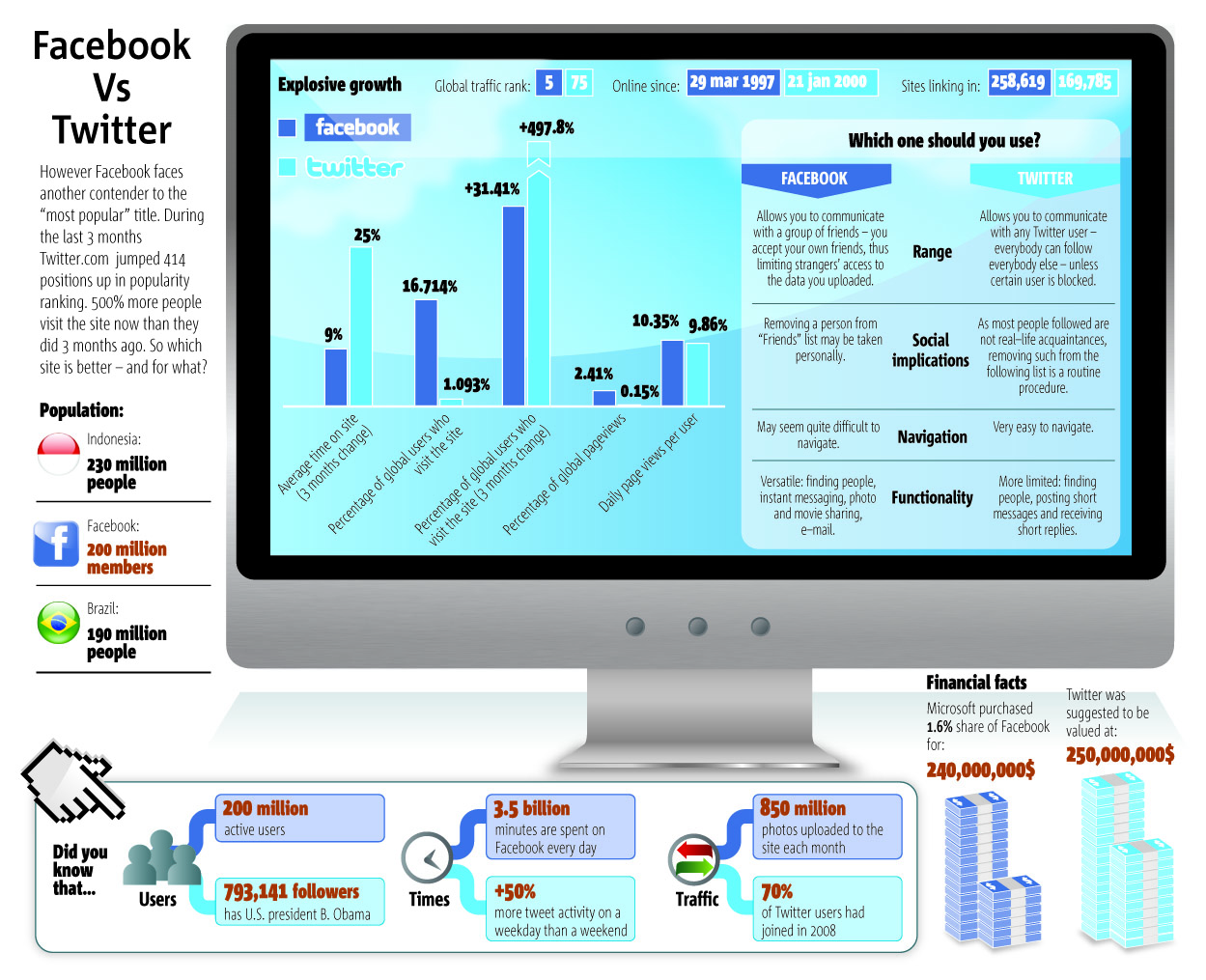
4. Facebook VS Twitter

Although one is a social networking websites whereas the other is a micro-blogging platform, but both have been ruled as “arch-rivals”. The “Facebook VS Twitter” infographic depicts the exponential growth of the two websites.

*The statistics are outdated, but at least it’s worth taking a look.

fb


5. More Truth About Twitter – Twitter Stats

Based on surveys and statistics, InformationIsBeautiful has designed an infographic that shows the percentage of active and non-active Twitter users; the number of people out of 100 whose tweets are pointless babble, and when are the peak days and hours.


6. The History of Twitter, So Far

In July, we gathered information from various sources and compiled the list of “The History of Twitter in pictures“.

However, Manolith has done a better job in telling the story of Twitter by squeezing a long-form blog post into an attractive infographic that puts some key moments of the serviceĆ¢€™s history in visual form.


7. Le Twitter Hack

Apparently, Twitter needs better security. The “Le Twitter Hack” infographic shows a timeline of events regarding the July’s Twitter attack.

Credit: techxav.com

Read More

Wednesday, December 23, 2009

Opera 10.5 pre-alpha goes Chrome hunting

The latest Opera browser preview version may not be entirely stable, but it's definitely got its jetpack strapped on. Opera 10.5 pre-alpha, for Windows and Mac, is the first browser that's not powered by Webkit to approach JavaScript rendering speeds previously reached only by Chrome and Safari.

In empirical testing done on an HP desktop running an Intel Core 2 Q6600 at 2.66GHz with 4GB of RAM and Windows 7 32-bit, the pre-alpha scored 435.6 milliseconds in the SunSpider JavaScript benchmark. By contrast, Google Chrome 4.0.266.0, the most recent development build, notched 510.4 ms. The current stable build of Opera was more than 7.5 times slower, at 3284.4 ms.

Opera attributes this dramatic improvement to the new Carakan JavaScript engine, which they have designed from scratch to replace the Futhark engine in the stable build. Opera 10.5 also includes improvements to the Presto layout engine, and a new graphics library called Vega.

Other improvements noticeable in the pre-alpha include changing the URL address bar to include the same style of predictive smart search that Firefox and Chrome have, and the search and address bars now both remember searches, support deleting specific items, and have redesigned layouts.

The main browser interface has been redone, too. The tabs are now on top, the menu bar has been minimized behind a drop-down on the left nav, and the browser has better integration with Windows 7 and Snow Leopard. On Windows 7 there's Aero Peek and Jump List support to access Speed Dial and tabs from the Taskbar. For Macs, there's a unified toolbar, native buttons and scrollbars, multitouch gestures, and Growl support. Dialog boxes are now non-modal, which you means you can now switch tabs without a pop-up commanding your browser's focus, for example. This will affect verification and authentication pop-ups, and JavaScript alerts.

There are some known problems, including a lack of printer support in the Mac version and noticeably high memory usage. Users can expect these to get addressed before the stable build of Opera 10.50 is released. The Opera 10.50 official announcement and changes can be read here, while the current stable version of Opera 10.10 is for Windows, Mac, and Linux.

source: http://download.cnet.com/8301-2007_4-10420544-12.html
Read More

Business, Outsourcing Articles: Read For More Information

Contact Us / Reach to Us / About Us

We are Offshore Software Development Company in India. We Offers Software Solution Services like Custom Software Development, Web Development, Custom Web Development, Web 2.0 Designing and Web 2.0 Development & Magento Development Services. We also provides Portal Development Services for B2B Portals and B2C Portals. Web Promotion is a key of Successful business, we offer Web Promotion, Internet Marketing and Web Site Optimization Services to rank website top in Search Engine Ranking Pages. Contact Us and Get a Free Quote about Our Offshore Solution Services.