Showing posts with label seo. Show all posts

Monday, February 22, 2010

Useful Advantages of SEO in Web Marketing

The importance of web marketing cannot be ignored nowadays. It has, in fact, become the basic ingredient for the success of a business in the real world and in the online world. It provides excellent opportunities to improve the sales and increase the revenue generation. For this purpose, the search engine SEO is a must.

Utilizing the capabilities of the search engines for one's profit is very important nowadays. It is something that can increase your chances of improved internet visibility and better Google results. As the SEO Services help the customers achieve this target, they are highly useful. They take advantage of all the options available in optimizing the nitty gritty of websites and its contents in such a way as can be beneficial for the customers and visitors alike.

There are certain tools that are used for this purpose. They are all part of search engine optimization services. It is a service that helps the customers in making their websites more web search friendly which, in turn, attract more visitors. As more traffic is a virtual assurance of better sales, there is likelihood that the revenue would jump up. It is also goo for online business identity.

One of the most commonly used techniques in this regard is called the on page optimization. It allows the expert SEO's to make changes to the website pages in the live mode. Certain aspects of the web pages are corrected, some are optimized and some are removed in a way to make sure that they are perfectly according to the liking of the search engines. When a search engine crawls a page, it looks for certain important information. If they are found correct or optimized for the search engine, they will get higher ranking in the results. Continue Reading
Read More

Wednesday, February 17, 2010

SEO friendly content management system

Content Management System (CMS):

Content Management System permits web site administrators to update, add or to delete the content, documents and photos to their web sites in “real time”. Content Management Systems generate an active web site milieu, where the entire content is stocked up in a database or in a XML file. In the era of high paced world of web, a high-quality CMS is vital to the proficient operations of a web site and Netzwerkinstallationen. CMS (Content Management System) permits the web site owner to outsource their content development tenuously to contract copywriters and further agreeable contributors.

CMS in SEO souk:

One of the chief and significant things that people should consider while looking for content management systems (CMS) is their practicality in the SEO souk. People at the time are really very confused about picking up a CMS that is absolutely compatible to their needs. To eradicate such confusion out of the minds, here are some of the SEO friendly content management systems:

Typo3:

Typo3 is very friendly to search engines and comes with lots of alternative for metadata and also for urls that are counted as search engine friendly.

Elxis:

Elxis is amazingly search engine friendly and deserves a good place in the list of systems. It is built up with SEO Pro capabilities. Even Mambo and Joomla are not capable of surpassing this.

What is SEO Pro..?

Elxis CMS produces search-engine as well as human friendly URLs with its powerful mechanism of working. SEO PRO is an essential part of the Elxis core; it is not a constituent or some class of additional software. Moreover, SEO Pro not demands any kind of supplementary settings other than its commencement.

The URLs are robotically produced from Elxis and are entirely based on SEO titles. This also increases the validation of SEO friendly titles.

Drupal:

Enable the sparkling urls and with a choice of SEO friendly plugins, Drupal is a well- known and a trouble-free content management system which is absolutely search engine friendly. Drupal works with an amazing module known as SEO Checklist.

MODx:

MODx is the most preferred choice and comes with capability of adjusting the meta- content for your website. Meta-content adjustment is done on the basis of per-page. Urls are completely SEO friendly.

Content Management System (CMS) Made Simple:

If you really want to amend .htaccess files, this unique and adjustable system can generate great quality of SEO friendly URLs. Also, it can build up variety of Page titles and Meta tags in an automatic manner and that can also be updated manually for individual pages later.

Overview:

It is sure that SEO friendly content management systems definitely work for you. The most important key is to search out for a CMS that will perfectly suit to fulfill your core needs and can conclude about the beneficial add-ons as well. Hence, you will get the ultimate results for your websites.


Source: freehelpsoft.com


SEO friendly content management system Re-Posted By Software Solution Services

Sponsored By: Software Development Company | TYPO3 Developer
Read More

Monday, February 8, 2010

Google warns Chinese copycat website: report

BEIJING (AFP) – Google has warned a copycat Chinese website to stop using a logo that resembles the US Internet giant's or face possible legal action, state media reported Monday.

The warning issued to the "Goojje" website comes as Google is contemplating its future in China after saying it would no longer obey government censorship rules and could pull out entirely over alleged cyberattacks.

Google accused Goojje of infringing on its trademark rights, saying the logo of the Chinese website could make users believe it was authorised by or linked to the US company, the Shenzhen Economic Daily reported.

In a letter sent to Goojje by Google's lawyers, the US Internet firm demanded the Chinese site stop using the logo by Monday, the report said.

Google China did not immediately respond to an AFP request for comment.

Reports have said Goojje was launched last month by a 20-strong team led by a college student identified only by the surname Wen, after Google issued its threat to pull out from China.

The operators of Goojje have posted vague statements on the website construed by some media as offering support for Google.

Goojje's homepage imitates Google's design and its Chinese name ends with a character that means "big sister". Google's Chinese name, meanwhile, ends with a character that is a homonym for "big brother".

Google said last month it would no longer abide by Chinese government censorship and was mulling leaving the country with the world's largest number of online users, citing cyberattacks on it and more than 20 other companies.

The Chinese government has denied any involvement in the cyberattacks.

The Google row has added to tensions between Beijing and Washington on a range of other issues including trade, US

Source: news.yahoo.com


Google Update NEWS Re-Posted By Affordable SEO Services Provider Company India

Read More

Thursday, February 4, 2010

Is Article Marketing Still Effective In 2010?

WritingDon’t exactly know what it is about starting a new year of marketing online, but I always stop and take a hard look at all my marketing tactics and methods. Article marketing is always at the top of my list, mainly because it is and has always been the cornerstone of everything I do on the web.


By cornerstone I mean it is the key to basically all of my online earnings. Without article marketing I wouldn’t be a full-time online marketer – it’s as simple as that. No articles,

no income.

Articles bring in the targeted traffic. Articles build those all important one-way backlinks. Articles build those even more important top rankings in Google for your chosen keywords. Articles build your online reputation and credibility in the eyes of your visitors.

I was struggling on the web for around three years before I wrote my first article. “10 Reasons To Put RSS On Your Site” which is still on around 8,000 sites around the web.

Writing was always a passion of mine, but it was more on the creative side, although I did work briefly as a reporter for a very small community newspaper. Looking back on it, I believe (perhaps falsely) that I had to gain all those years of experience before I could start writing articles about it.

Which was the totally wrong attitude to take since anyone can research a favorite subject or topic and write a short informative article on it. Most of us have been doing that since grade school – it is the same as writing a report or an essay.

Only with article writing you actually see monetary returns almost immediately. Surfers search for an answer in the search engines, your article pops up, they read it and then click the link to your webpage where you have conveniently placed your affiliate links or your own products.

A Small Percentage of Those Article Readers Will Buy Your Products and You’re in Business.

Over time, all those backlinks in your resource box at the end of your article will make your keywords rise in the search engines, especially Google. Then as someone searches in Google – your site pops up, they click thru to your webpage and a small percentage of these visitors will buy your product or affiliate product displayed on your page.

Smart marketers will also start building a large list of prospective customers by offering a free guide, ecourse, ebook or software program to get those visitors to sign-up to your opt-in list. These marketers can then do follow-up with all these potential customers.

That in a nutshell is an article marketing model or funnel which thousands of online marketers and webmasters are using. And have been using for years.

But Will Article Marketing Remain Effective in 2010 and the Coming Years?

More than likely the answer would be yes but the web is constantly changing and there are other games worth playing. The same kind of marketing system could be done with Videos, Blogs, Social Networks and even with Twitter. Your options are more varied…

However, I find article marketing can be integrated into all these elements. For example, EzineArticles lets you Tweet your articles to all your followers. I turn my best articles into Videos and place them on YouTube which opens up a whole different flow of traffic to my webpages and affiliate links.

Likewise, you can place your articles or links to them on FaceBook, MySpace and the other social networks. I find getting your articles on Digg, Reddit, Stumbleupon… can bring in a lot of traffic and increase your rankings.

But the Question Remains – is Article Marketing as Effective as It Once Was?

My own answer and personal opinion is no since it’s effectiveness has been watered down somewhat because every “tom dick and harry plus sally” is doing it. Everyone has discovered how writing short informative articles on the topic of your site can be very lucrative.

When I wrote that first article five years ago, I was ‘writer #1561′ with Ezinearticles. Now they have over 242,000 writers!

Back then, I found your article was placed on a lot more sites mostly because there wasn’t that many articles out there and competition was much, much less than it is now. More people writing more articles simply means your article falls into a bigger pool of other articles.

I believe video marketing is at the stage article marketing was at around five years ago. So turning your articles into short “how to” videos would probably be a wiser move and you would have a lot less competition. You can also place your marketing into the whole Video/Youtube craze that is still bringing in tons of traffic and interested customers.

However, the popularity of free article directories have grown and some of these sites have very high traffic numbers. Here are some of the main ones I use:


  • EzineArticles
  • GoArticles
  • iSnare
  • IdeaMarketers

And I also like to place my articles on important but perhaps lesser known sites such as:


  • PromotionWorld
  • SelfGrowth
  • American Chronicle
  • Buzzle

However, article marketing is still a very good way to get your site and name on the web. It can still bring in traffic and help build those all important backlinks and search engine rankings. This is one marketer who will not be giving up article marketing any time soon.

Some of my most effective techniques for article marketing are:


  • Place your targeted keyword phrase in the title, usually at the beginning.
  • Make sure your article is informative and supplies the information a reader is searching for – but always try to motivate the reader to click your links in the resource box for further information since your main objective is to get the reader to click thru to your site.
  • Most experts say to keep your article short, around 400 – 700 words, but I have found longer articles of 800-1500 words do really well.
  • Place your targeted keywords in the anchor text of your resource box links, that’s the underlined clickable part. Vary these keywords to avoid keyword spamming.
  • For very important sites, try writing an exclusive unique article for that site alone.
  • Always spell-check and proof-read your articles. Grammar has never been my strong point so what I do for finding the correct usage of some tricky phrases or words – I do a search in Google with “quotation marks” to find out which one has the most links/usage… I go with one that has the most links, even if it’s wrong. Thousands of people are making the same mistake. Many marketers do the same thing with misspelled keywords.

While they can be expensive, I also like using paid article submission sites such as SubmitYourArticle, ThePhantomwriters and Isnare… mainly because article marketing has been so profitable for me, I don’t mind pouring some of those earnings back into those sites. It saves me time and extends the reach of my articles.

Article marketing will continue to be one of your best ways to build backlinks, raise your rankings and bring in potential customers to your site. It still works for me and hundreds of thousands of other webmasters – it should also work for you.


The author is a full time online affiliate marketer who operates numerous niche sites, as well as two sites on Internet Marketing, where you can get valuable marketing tips for free: internet marketing tools (http://www.marketingtoolguide.com) or try here: free marketing courses (http://www.bizwaremagic.com/ Free_Marketing_Courses.htm) Titus Hoskins Copyright 2010. This article may be freely distributed if this resource box stays attached.

This article courtesy of SiteProNews.com


Article Re-Posted By: Ashi Software: Software Development Company offer TYPO3 Development Services
Read More

Wednesday, February 3, 2010

Keyword Density Importance for Ranking on Search Engines

SEO experts may well help customers choose the right set of keywords that are quite logical and expected performance results. Usually visitors to the lack of patience and are always short of time to go through other search results pages, which makes concentrating on the first page itself. Therefore, it is clear that if it falls on its website the results of the first page, then your site is definitely going to improve business.

The level of success of your site depends largely on the research of key markets. go for exact keywords with small rivalry, highly competitive keywords reduces their chances of being caught in the search engine results. For all your site's web pages apply dissimilar page titles with different keywords. The cause for using dissimilar keywords in dissimilar web pages ie, increases the possibility of getting the place in search engines for more than a set of specific keywords.

The SEO expert analyzes the website and see where the website owner has used the specified keywords on the site. They pass through the site content and the title of the link. The main object of this investigation is to resolve the near condition website in search engines and developing an effective SEO strategy. It also serves as the perfect guide to the areas of search engine optimization of your website needs more attention and concentration.

After making the selection of images to upload to your website, then go about optimizing them to reduce load time. all through the image optimization method, all needless information is unconcerned to reduce file size. If done in the suitable arrangement the exterior of the image would stay the same. For a site of an image should be wide between 200-400 pixels. The maintenance of this size would place the image in the proper format on the website and also leave enough space for menus and content.

The format in which to save the image affects the way it is perceived as a logo or an image. Take all essential events to optimize the picture on your website and make sure that loads in less time period. With the use of image editing software to remove extra information thats not wanted, you can reduce image file size without compromising with his gaze. Select the image is good quality and have used less bytes. These tools can reduce the size of the chart up to 70% still maintaining the quality of the image
Read More

Wednesday, January 13, 2010

Baidu hacked by 'Iranian cyber army'

China's most popular search engine, Baidu, has been targeted by the same hackers that took Twitter offline in December, according to reports.

A group claiming to be the Iranian Cyber Army redirected Baidu users to a site displaying a political message.

The site was down for at least four hours on Tuesday, Chinese media said.

Last year's attack on micro-blogging service Twitter had the same hallmarks, sending users to a page with an Iranian flag and message in Farsi.

"This morning, Baidu's domain name registration in the United States was tampered with, leading to inaccessibility," Baidu said in a statement.

Visitors to the site were greeted with the message: "This site has been hacked by Iranian Cyber Army".

The message was accompanied by a picture of the national flag of Iran.

"In China, Baidu outranks Google as the search engine of choice, receiving millions of visits every day. That makes it an extremely attractive target for cybercriminals," said Graham Cluley, senior technology consultant at security firm Sophos.

Political graffiti

It is not yet clear whether the site itself was compromised or its so-called DNS records.

DNS records are like a telephone book, converting website names like baidu.com into a sequence of numbers understandable by the internet.

"It's possible someone changed the lookup, meaning whenever surfers entered baidu.com into their browsers they were instead taken to a website that wasn't under the search engine's control," explained Mr Cluley.

It seems as if the hackers used the attack as an opportunity to create political graffiti rather than inflict real damage.

"If that third party website had contained malware then millions of computers could have been infected and identities stolen," said Mr Cluley.

"Attacks like this are a reminder to everyone that you always need to have security scanning every webpage you visit, even if it's a well-known legitimate website," he added.

Source: BBC NEWS
Read More

Tuesday, January 12, 2010

10 Search Engine Optimization Tips

Anchor Text: This is basically the words used that link to another URL. For maximum benefit of any backlink you need to have the correct anchor text. The text needs to include keywords of whatever your linking to. An ideal example would be my website, if I was linking my homepage in a forum I would use “how to make money online” as the Anchor text. If you don’t do this the SEO benefit will be minimal

Blog Directories: Blog Directories can be useful but it depends on how much time you have whether it’s worthwhile doing or not. For the average person I would never recommend submitting to more than 30 sites simply because there are other actives that will have a far greater effect for your time. Firstly the PR is shared around each outbound link so if you have a directory with 200,000 sites indexed; your section of the PR pie is going to be minimal. Secondly even a PR8 directory will only give you a tiny amount of PR because the page you have your website linked is probably PR0. So it’s worthwhile as part of SEO is about variation but avoid doing more than 30.
Outgoing Links: The more outgoing links on your page the less Google will like you. If you stick to links that are good quality and relevant to your content, the better it will be. I see too many blogs with 100’s of outgoing links just for the sake of it that are not often content relevant and it’s a complete waste of time. Only create an outbound link when it’s necessary and not just for the sake of it.

Internal Links: This is an absolute must yet very few people do it. Having a good internal link system will be very effective search engine optimization. Every link you create is internally is like having a good backlink. Just make sure you use the right anchor text as mentioned in point 1, otherwise this exercise is pointless. (Think Wikipedia...internal links = 2 trillion gazillion)

Keywords: This is not an absolute definite but generally believed that you should include your keywords no more than 7 times per 100 words. The reason for this is because Google’s spider will thing you are spamming for the sake of SEO. I am unsure of how accurate those numbers are but be wary of it.

Subject Relevant Link Exchange: Link Exchanges are a great way to get your blog/site off the ground and also for the more established ones as well. For best effect be sure to exchange with subject relevant sites otherwise it’s pointless and Google wont respect you for it. Take your time when finding the right exchange and it will benefit you greatly.

Quality Link Exchange
: As I mentioned in point 2 about blog directories. PR “juice” will be shared between every outbound link on a site. With that in mind, when acquiring a link exchange be sure to trade with someone with a blogroll bigger than the empire state building. Otherwise your backlink will count for much less than your much more respectable size 10 of the most blogroll.

Good Traffic: When going on a quest to gain more site traffic, it is important to try and get “good” traffic. This may sound obvious but so many people will spam sites with their URL and get a few clicks, but it will bare rare that any bookmark the site because they just don’t care about what you have to say. Try to focus your precious time on gaining good quality traffic by submitting your link to places where they will find your site of interest.

DoFollow: DoFollow basically means it will most likely have a positive effect on your Search Engine Rank. NoFollow means the chances are it won’t have a positive effect on your Search Engine Rank. With that in mind if you want to post your link on forums/blogs ensure they have the status “DoFollow” otherwise it’s most likely your efforts will be futile.

Your Reputation
: Although this is not directly Search Engine Optimization, it is still very relevant. Your site reputation is everything, be sure you keep it as high as possible. Avoid link dropping just for the sake of gaining a cheap backlink; take your time to give a positive input with quality info. This will gain you much better results and have a much higher chance in people wanting to view that link in your signature or give you higher forum reputation.

Source From Digital Point Forum
Read More

Tuesday, January 5, 2010

Submit your blog to Bing search engine

It is not enough to submit your blog to Google search engine alone. You should look for other renewed search engine as well, like Bing. Today I am going to discuss how to add your blog in Bing search engine to attract more traffic to your blog.

Carefully follow these steps to submit your blog to Bing search engine

step-1

Click here to go to URL submission page of Bing(you must need live or hotmail id to log in. So, if you don't have one then create now).

step-2

If you successfully log in then you will see the following page. Provide 'Web address' and 'Sitemap address'. You can also provide Webmaster e-mail,but this is optional. And then click on Submit button.


step-3

At this step you have to make sure you are the owner of the blog. For authentication purpose they provide two option, XML file(which you have to upload) or Meta tag. As we are talking about blogger blog, means you have to opt second option.


Upload meta tag -

Copy the meta tag
Next go to Blogger.com dashboard -> Layout -> Edit HTML then check Expand Widget Templates
Now, paste the code in between <> and < /head >

You are done
Bing Information Credit Goes to: takeme2yourheart.com
Read More

Saturday, January 2, 2010

What is the idea behind getting the keywords searched?

"What is the idea behind getting the keywords searched? The importance of Keyword and Keyword Phrases in Search Engine Optimization can be described as follows:

Keyword and Keyword phrases is most important feature of any Search Engine Optimization scheme. You may have put much of your hard work on tuning fine your web pages for a greater ranking in the major search engines like Google, MSN, and Yahoo. Mere keywords are not just enough if the right keyword phrases are not targeted. It is just like not getting able to reach to correct destination after all our best efforts just because of selecting a wrong path. Even if you attain high search engine rankings, you may not get appropriate traffic if you select the wrong keywords. It is required to focus on exact location, exact region or exact country; the specification could be business, trade, service or product, since we are talking specific audience.

The keyword search tools help you to get hold on target audience. We have to start doing Keyword Research going by the facts and the keyword Research process involves the following four important steps as follows:

1. Discovering Keywords.
2. Analyzing Keywords.
3. Selecting Keywords.
4. Deploying Keywords
Read More

Wednesday, December 30, 2009

Successful Internet Marketing

Successful Internet Marketing Little Mistake You Are Making That Is Costing You A Lot Of Potential Money

Read More

Tuesday, December 29, 2009

Social Media Marketing With Twitter – An Introduction

As a business owner, you have likely heard of social media marketing. You may even have been curious enough to investigate it. And you may have been overwhelmed by the many options available to you. Between Digg, Delicious, Facebook, LinkedIn, Twitter and all of the many others, it is difficult to know where to start.

Twitter is one of the newer entries in the social media marketing field. Launched in 2006, it has become an enormously popular way for people to connect and keep in touch. Like any form of social media, it has also attracted businesses keen to get on the bandwagon of social media marketing.

Using Twitter as a Marketing

Twitter is often referred to as a micro-blog. Instead of posts, you write “tweets” of 140 characters or less. You can follow other users with similar interests, and they can follow you. Each time you add an update, all of your followers receive a message. They can choose to respond or not.

As with any social media marketing site, using Twitter requires you to be involved. You need to follow and be followed. You also need to provide information of value to the people who follow you. One example is links to your blog or other relevant information on your site.

Using Twitter for marketing does take time (as does any attempt at social media marketing). You need to build a community of followers and engage with other users to create credibility. To make links, you have to have something interesting to share with people, which means you need to spend time creating enough current, relevant, interesting and (occasionally) thought-provoking content for your followers to read.

Tips for Using Twitter as Part of Your Online Marketing

There are some basic rules to follow when using Twitter for marketing. In fact, many of these rules apply to other social media sites too, like Facebook.

Do not spam or engage in hard selling. Remember to be sociable and offer information of value. Blog posts on the benefits of your product or services, interesting conferences or professional development opportunities that are coming up – these are good examples.

  • Always link back to your site or blog. That is why you are doing this in the first place.
  • To get followers, put a link on your site or blog inviting people to follow you on Twitter. Twitter provides the code for a “badge” that you can drop into your Website or blog.
  • Search Twitter for likeminded users/businesses and see who they are following. You may be interested in following the same users.
  • Follow the lead of those who came before you. There are users with hundreds of followers. Check out what they are tweeting about so you can get ideas.

Use Twitter as Part of a Detailed Social Media Marketing Strategy

Of course, if you are using social media for marketing, you need to have a comprehensive plan. To create a plan like that, you may need help from a search engine marketing consultant. In addition to tweeting on Twitter (which can eat up a lot of your time) you need to have a schedule for blogging and writing articles to link to.

As part of this strategy, develop a plan for your content. Don’t throw any old thing up there just to have something to link to. A consultant can show you how to create compelling copy that makes your blog, articles and Website work with your social media marketing, so that you are drawing traffic through as many channels as possible.

Source From: homebasedblogging.com
Read More

Friday, December 25, 2009

7 Creative and Interesting Infographics about Twitter

By Xavier Lur

With over 54 million users worldwide and close to 7 billion tweets being posted, Twitter is the world’s most popular micro-blogging platform, fueled by smartphones and online bursts of 140 characters. 2009 is the year of Twitter. It soared to lofty heights over the past year, all thanks to the active presence of celebrities such as Ashton Kutcher and Oprah Winfrey. The San Francisco-based Internet company isn’t a social networking website like Facebook or MySpace. Instead, the main focus of Twitter is about real-time information of the things you care about — work, industry, company, news.

2010 will be the revenue year of Twitter. The micro-blogging juggernaut will focus on generating revenue in the year ahead, and may explore options including an initial public offering. “2010 is really going to be the revenue year. I don’t know if we’re going to be profitable, but we have plenty of time,” said co-founder and creative director Biz Stone during an Oxford University event in November.

Today, I’d like to share with you guys ‘7 Creative and Interesting Infographics about Twitter‘. Enjoy and don’t forget to tweet about this post! :D

1. The Journey of a Tweet

Timon Singh from NGONews has created an infographic which shows the journey of a Tweet and how it evolves from a simple 140-character long message to a Google news story.

journey


2. The Many Users of Twitter

Ordinary people use Twitter to share with their friends and co-workers what they are doing; bloggers, Internet marketers, and businesses use Twitter to promote their articles/products; politicians use Twitter to garner support; celebrities use Twitter to stay in touch with their beloved fans, and spammers use Twitter to send unsolicited messages.

Inspired by Guy Kawasaki, “The Many Users of Twitter” is an infographic designed by the folks at NGONews. According to Guy Kawasaki, there are six types of Twitter users – Newbie, Brand, Smore, Bitch, Maven, and Mensch. So which one are you?

profiles


3. Information creation and circulation before and after Twitter

Designed by Burson Marsteller, the “before Twitter” infographic shows that time is necessary for the information to spread before its arrival on Twitter. On the other hand, the “after Twitter” infographic reveals the changes of the information circulation with the development of the use of Twitter.

Before Twitter

beforetwitter

After Twitter

aftertwitter


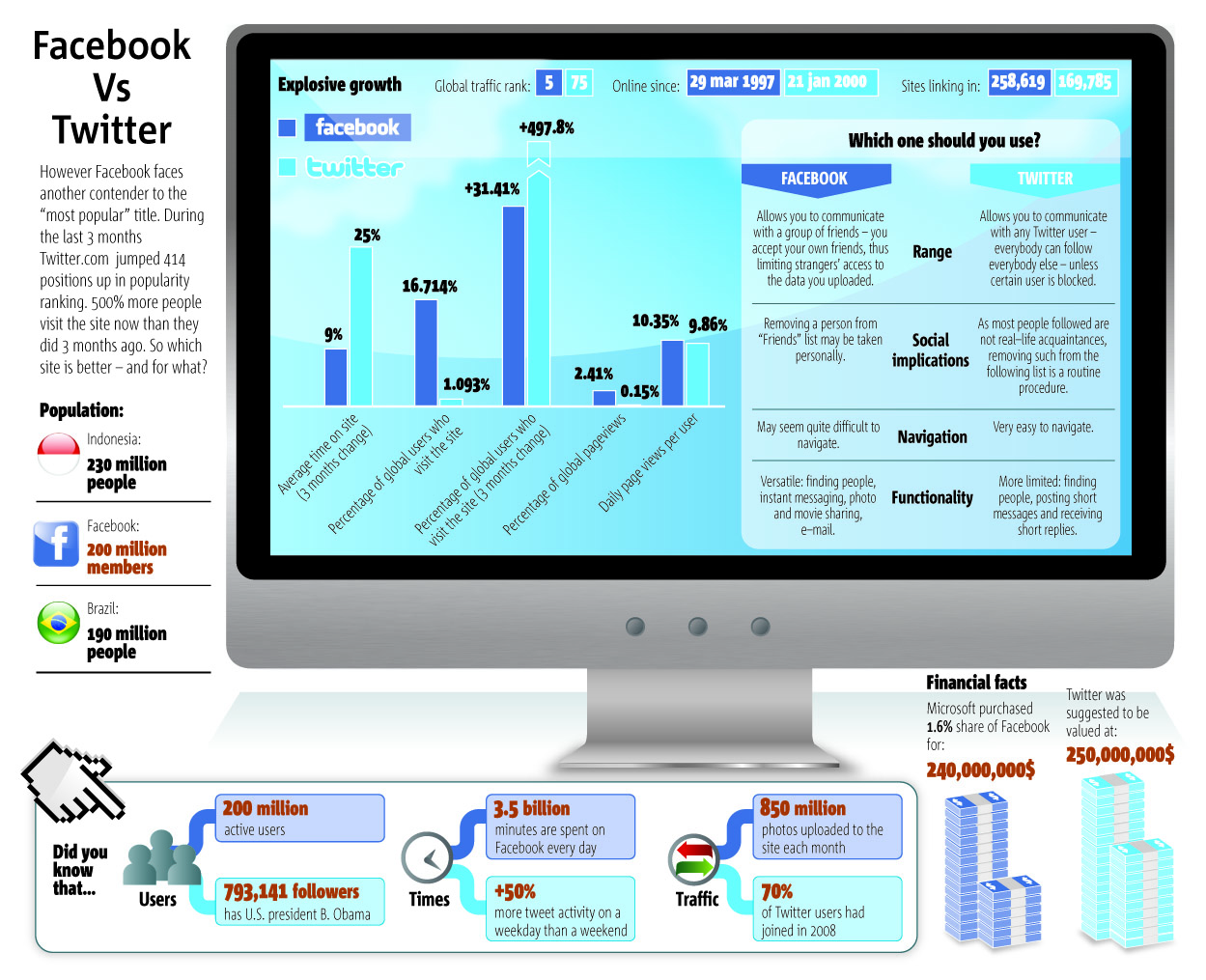
4. Facebook VS Twitter

Although one is a social networking websites whereas the other is a micro-blogging platform, but both have been ruled as “arch-rivals”. The “Facebook VS Twitter” infographic depicts the exponential growth of the two websites.

*The statistics are outdated, but at least it’s worth taking a look.

fb


5. More Truth About Twitter – Twitter Stats

Based on surveys and statistics, InformationIsBeautiful has designed an infographic that shows the percentage of active and non-active Twitter users; the number of people out of 100 whose tweets are pointless babble, and when are the peak days and hours.


6. The History of Twitter, So Far

In July, we gathered information from various sources and compiled the list of “The History of Twitter in pictures“.

However, Manolith has done a better job in telling the story of Twitter by squeezing a long-form blog post into an attractive infographic that puts some key moments of the service’s history in visual form.


7. Le Twitter Hack

Apparently, Twitter needs better security. The “Le Twitter Hack” infographic shows a timeline of events regarding the July’s Twitter attack.

Credit: techxav.com

Read More

Tuesday, December 22, 2009

Google open-sources XML-alternative Protocol Buffers

XML, it seems, has run out of steam for Google.

Google said Monday that it has created an open-source project for a data interchange format called Protocol Buffers.

The software is meant to solve the problem of sharing information in a wide range of formats between servers at high speed. It’s also designed to let companies like Google upgrade software on a network of connected servers without causing hiccups.

Google thought of using XML as a lingua franca to send messages between its different servers. But XML can be complicated to work with and, more significantly, creates large files that can slow application performance.

Protocol Buffers is an alternative way of describing the format of data that is being sent over the network or stored to a hard drive. Unlike XML, it’s a compact format and is designed to be simple to use, according to Kenton Varda of Google’s Software Engineering Team.

Varda wrote in the company’s open-source blog:

Protocol Buffers allow you to define simple data structures in a special definition language, then compile them to produce classes to represent those structures in the language of your choice. These classes come complete with heavily-optimized code to parse and serialize your message in an extremely compact format. Best of all, the classes are easy to use: each field has simple “get” and “set” methods, and once you’re ready, serializing the whole thing to–or parsing it from–a byte array or an I/O stream just takes a single method call.

Matt Cutts, a software engineer who heads Google’s Webspam team, said in a blog late Monday that Protocol Buffers automatically generates Java, Python, or C++ code:

Think of Protocol Buffers as a very compact way of encoding data in a binary format. A programmer can write a simple description of a protocol or structured data and Google’s code will autogenerate a class in C++, Java, or Python to read, write, and parse the protocol. Given a protocol buffer, you can write it to disk, send it over the network wire, and do any number of interesting tricks. Any medium-sized company (and quite a few startups!) should find Protocol Buffers very handy.

The software is available the Apache Software License 2.0.

Like a lot of what Google’s engineering team does, this seems to make sense. XML has long been criticized as being too slow, which has led to controversial efforts to standardize XML compression.

But given the huge investment in XML, it doesn’t look like Protocol Buffers will replace it. Instead, it will be used–certainly by Google and likely others–for Web applications that need a very efficient way to move around data in multiple formats.

Source: http://news.cnet.com/8301-10784_3-9985254-7.html?
Read More

Microsoft preps pay-as-you-go Web apps for Business

Microsoft detailed on Tuesday its road map and pricing for Web-based software suites built for big companies and growing businesses.

Enabling telecommuting, which many employers and workers increasingly favor, is likely to be a selling point for the productivity and “deskless worker” tools within the Microsoft Online Services lineup.

The move is part of Redmond’s push to integrate online and desktop software, shifting much of the heavy lifting to the “cloud.”

“Microsoft Online Services is a key component of the software plus services initiative, and we’re seeing customers, partners and even competitors embrace this flexible approach to the cloud,” Stephen Elop, president of the Microsoft Business Division, said in a statement.

Details were unveiled Tuesday in Houston at the Microsoft Worldwide Partner Conference.

For $15 per month per person, the business productivity suite offers an Outlook-integrated Exchange Online for e-mail and calendars, Office SharePoint Online collaboration, messaging via Office Communications Online, and Office Live Meeting video-enabled Web conferencing.

The software giant will charge another $3 per month per user for the Deskless Worker Suite, which combines flavors of SharePoint Online and Exchange Online. The SharePoint portal offers access to internal company sites and search. E-mail, calendars, security filters, and Outlook Web Access Light are included with Exchange Online Deskless Worker.

Microsoft aims to simplify otherwise complex corporate tasks managed by engineers or IT technicians. For instance, a WYSIWYG interface would enable an IT worker to give a new employee access to the company tools in a series of steps that could be shorter than setting up, say, a free Hotmail or Yahoo e-mail account.

One can sign up online to try the beta services.

Exchange Online and Office SharePoint Online remain in beta, with final availability set for sometime in the second half of 2008, when Office Communications Online beta is also due. Microsoft plans for international availability in 2009.

The company offers to pay resellers of its Online Services 12 percent of the price of each contract secured during the first year, and 6 percent per subscription year thereafter. Interested companies can learn more at Microsoft’s QuickStart Web site.

Microsoft partners and resellers of Online Services include Accenture, CDW, and Unisys. Nokia is among the companies using the online tools for messaging and collaboration.

Source:http://news.cnet.com/8301-17939_109-9985201-2.html
Read More

Yelp, Google Breakup Bad News for Small Business

It is unhappy news that Google won’t be purchasing Yelp. It was a natural in terms of things Google should be doing, especially in helping small local businesses promote themselves.

The $550 million deal, which lived and died over the weekend, would have also made Google more of a one-stop for local businesses, who often don’t know where to invest their small promotion budgets. It also might have moved the reviews social network away from advertising sales that have challenged its credibility.

If Yelp has gotten a better offer and bailed on Google because of it, it’s bad news. Only Google brings the breadth of offerings necessary to be a good single purchase for small business. Nothing else is even close.

I hope Microsoft realizes this before trying to make Yelp part of Bing, although the names do sound like they belong together, if not the services.

As much as we don’t like near monopolies, they have their good sides. Local businesses realize they need the Internet, but don’t have the time or dollars to invest. Google offers many free and low-cost ways for local businesses to promote themselves online. Yelp does the same thing, though not as well.

Teaming the two would have allowed local businesses to do excellent local marketing, presumably at low cost, by dealing with only one trusted vendor, Google

Having said that, it is not clear Google would have known what to do with Yelp.

Ideally, there would be technical and back office integration, which fits with Google’s engineering-driven culture. More concerning, however, is whether Google could just sit and watch Yelp’s content and community management.

So far, in two attempts, Orkut and Knol, Google has failed to develop communities. YouTube has a community, of sorts, but is hardly a comparison to the level of community (or average IQ) necessary to make Yelp function.

Maybe it’s just as well for Yelp and Google go their separate ways, but as someone who cares about local businesses, I feel like an opportunity has been lost.

David Coursey has been writing about technology products and companies for more than 25 years. He tweets as @techinciter and may be contacted via his Web site.

Source: http://www.itnews.com/internet-based-applications-and-services/12259/yelp-google-breakup-bad-news-small-business
Read More

Monday, December 21, 2009

The New Look of StumbleUpon

The New Look of StumbleUponI don’t know about you but I love to “stumble” upon new things all the time. I noticed when I went to log in to my account the other day that the interface has changed. I have to say that I love the new look and feel of the new site design. Comparing it to the last version I notice a big difference in how much cleaner it is to look at and also how user friendly the new version is.

Apparently right now you have the ability to go back and forth between the new “beta” version and the old version but soon that will all change and the new interface will be here to stay.

In the old version after you stumbled on a certain website you liked or disliked it would be added to your profile as a thumbnail image - with so many thumbnail images this created a very cluttered view. The new Stumbleupon limits the amount of thumbnails to about 10 and then instead of thumbnail views you have a little larger image of the website along with what your comment was. Compared to the old version where you had to click on reviews to see the review you gave it.

I wanted to give props to the new Stumble interface - if you have not seen it yet - check it out.

Source: http://www.semplistic.com/articles/the-new-look-of-stumbleupon/
Read More

Saturday, December 19, 2009

New breadcrumb feature in search results part of Google Caffeine rollout?

Google is coming with some changes in Search Engine Listing Page. This chabges are qith URL shorten with Breadcrumb Navigation. Lilengine.com has present this very nicely with some images. Read rest of story with images in their own word.
Google's new SERP URL update

Google's new SERP URL update

Over the next few days we should see some changes in the way Google displays the URLs in organic SERP. Currently the URL listed in the search result is a citation based version of a page’s URL. It looks like this update is could be part of the Caffeine rollout, where Matt Cutt’s mentioned will only be rolled out on 1 server currently until 2010 – I am seeing the new breadcrumb result about 10% of the time when search for the phrase ’spidersapien reviews’.

The new version will take on a more breadcrumb feel based on the hierarchy of the webpage on the website. Which is determined by Googlebot if;

The information in these new hierarchies come from analyzing destination web pages. For example, if you visit the ProductWiki Spidersapien page, you’ll see a series of similar links at the top, “Home> Toys & Games> Robots.” These are standard navigational tools used throughout the web called “breadcrumbs,” which webmasters frequently show on their sites to help users navigate. By analyzing site breadcrumbs, we’ve been able to improve the search snippet for a small percentage of search results, and we hope to expand in the future.

This is a pretty significant update to how the SERP is displayed, for a long time SEOs have depended on including keywords in their URL or battled with web developers to dynamically generate SEO friendly URLs. Now with this new breadcrumb update, URLs will no longer be shown in the SERP. Which means less significance to SEO friendly URLs or the ability to create even more SEO friendly URLS by eliminating hierarchy information, judging from the quote – all one would need is a HTML navigational breadcrumb for this to work, much easier than doing URL rewrites. Surely there are other factors that Google look for as well ( sitemap / RDF info ? ).

How will this effect CTR? The new format certainly looks nicer, but as a power searcher I like to see the URL before clicking on a link, also one major loss from this update will be the keyword you searched for will no longer be in bold ( see before example ) which does have a positive impact on CTR, since the URLS that have the keyword hi-lighted tend to get more clicks.

Lets also compare the HTML code generated by Google;

New Google breadcrumb HTML
www.productwiki.com › Toys & GamesRobots
www.productwiki.com › Toys & Games

Robots
Old Google URL HTML
www.productwiki.com/spidersapien/ –

There is definitely a lot more code been generated here in the new format, which would justify Matt Cutt’s explanation for the caffeine update as the ability to return more search results faster with more content.

Source From: lilengine.com
Read More

Friday, December 18, 2009

How to exclude specific country or region from Google Analytics

Here are the quick and easy steps to implement, if you want a report of website traffic, excluding a specific country or territory.

However,it should be noted that, it is among the best practices to create new test profiles when you are testing our filters or otheradvanced analytics setups. The reason is that it is not unusual that some of your experiments might turn out to be wrong or do not meet your specific requirements, if you have multiple profiles, then you can safely delete the newly created one without loss of critical data. You should have one untouched raw analytics profile, always.

Having said that, lets move towards our setup, I have already created a new profile for the same website and name it “Filtered Traffic”

As soon as you create the new profile, click the edit button and scroll down to see the “Add New Filter” option.

f1

Kindly note that Google Analytics have 2 types of Filter Setups,i.e. Predefined and Custom, we will select the Custom Filter.

f2

Now select the Visitor Country option to mention the excluded region.

f3

Now in the “Filter Pattern” box, enter your desired value or values.e.g. Filter Pattern: brazil|Argentina

f4

Note:The pipe symbol | allows for multiples within the same pattern. Thus, you can mention one or many countries in the same pattern.

Another way is to put country names you want to exclude separated with | sign, and enclose it with ( ) in Filter Pattern field. For example if you want to exclude traffic stats from China, Australia and India the filter pattern will be(China|Australia|India) . And that’s all, now save this filter by clicking “Save Changes” button.

Kindly note that | and () are regular expressions, they have many uses, read about them at: Google’s Help Page


Original Source: blog.khmohsin.com
Read More

Business, Outsourcing Articles: Read For More Information

Contact Us / Reach to Us / About Us

We are Offshore Software Development Company in India. We Offers Software Solution Services like Custom Software Development, Web Development, Custom Web Development, Web 2.0 Designing and Web 2.0 Development & Magento Development Services. We also provides Portal Development Services for B2B Portals and B2C Portals. Web Promotion is a key of Successful business, we offer Web Promotion, Internet Marketing and Web Site Optimization Services to rank website top in Search Engine Ranking Pages. Contact Us and Get a Free Quote about Our Offshore Solution Services.